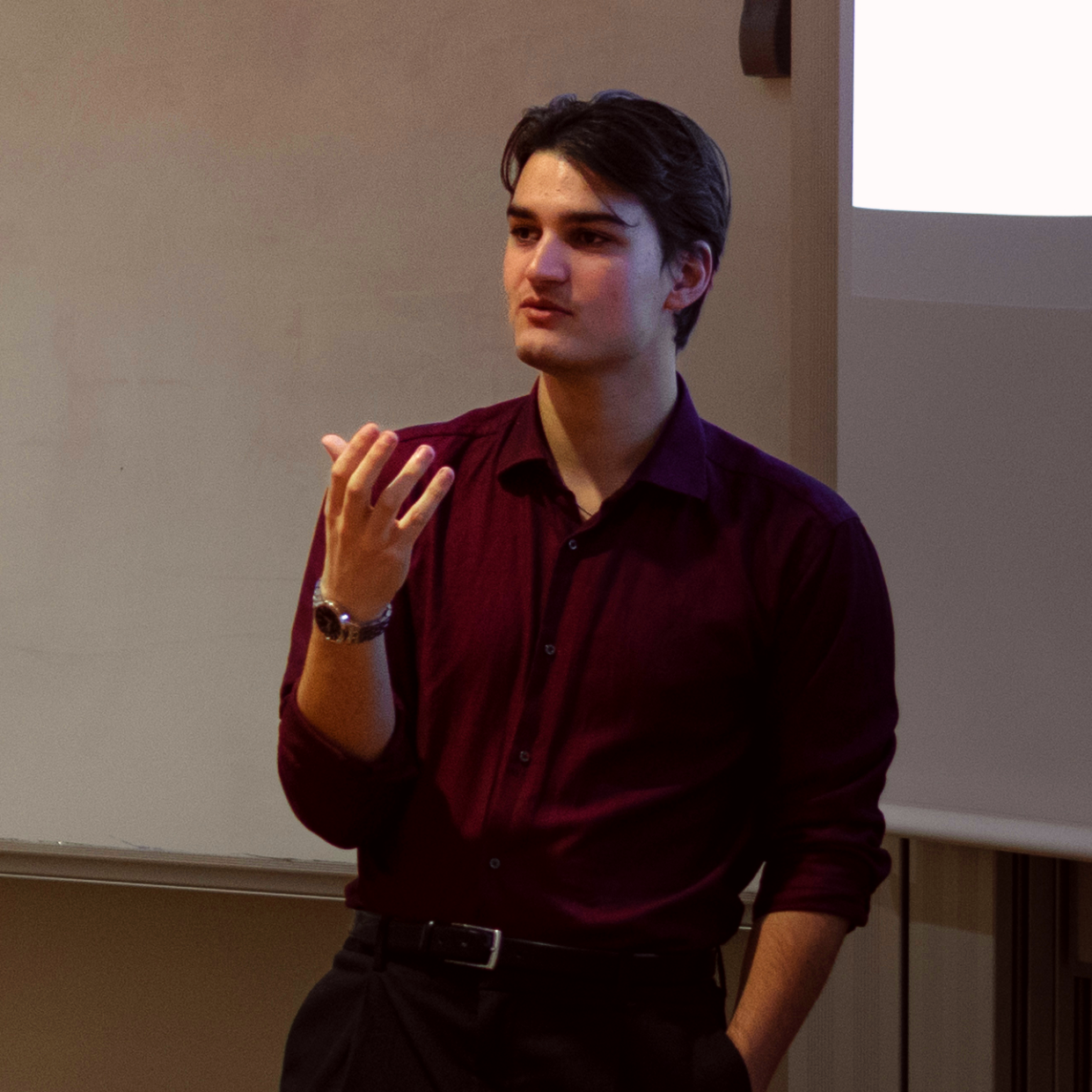
I’m Matei. I build AI systems and explore the ideas behind them.
Machine learning engineer, KTH graduate and writer at Digital Monastery. Working where modern technology meets classical philosophy and the Christian tradition.
An innovation platform connecting insights, opportunities and ideas. For innovation leaders to know which ideas to go ahead with.
Inside the work
Architected a full-stack data and innovation platform using Python, FastAPI, PostgreSQL and React to structure enterprise information and support data-driven decisions. Translated enterprise stakeholder requirements into technical roadmaps and production systems, solving business problems with data analysis and machine learning workflows. Built agentic RAG pipelines using LangChain, Docker, vector search and Gemini APIs, supporting document retrieval and structured multi-step LLM reasoning.
Servai
AI customer support systems for Swedish businesses. I co-founded Servai and built agents, data pipelines and integrations supporting more than 10,000 real customer conversations.
Inside the work
Engineered automated ETL data pipelines from unstructured datasets using SQL, Pandas and JavaScript, converting operational data into structured datasets for analysis. Analysed customer service data in Python and SQL, presenting business KPIs through Excel, Power BI and custom HTML and CSS dashboards to identify process bottlenecks and automation opportunities. Built and deployed AI-assisted classification workflows using Python, Azure and OpenAI APIs, validating model outputs through evaluation scripts and manual quality checks. Explained technical concepts to non-technical stakeholders in order to build solutions to real data problems within customer service.
What makes an intelligent system good?
Hylomorphic AI: Virtue-Based Ethical Alignment for LLMs
Can virtue inform how we align AI?
My MSc thesis asks how ideas from virtue ethics and hylomorphism can inform experiments on language models. The work connects a philosophical question to something we can inspect: the model’s internal representations.
I’m a machine learning engineer with an MSc from KTH Royal Institute of Technology. I’ve built AI systems for businesses, co-founded two ventures and taught programming and AI alignment.
Alongside that work, I read and write about classical philosophy and Orthodox Christianity. Digital Monastery is where those interests meet the questions raised by AI: What is understanding? What is a good life? What should our tools be for?
I care about building things that are useful, understanding their limits and keeping human purpose in view.
Co-Founder, AI EngineerTellintel, KTH Innovation, Stockholm
2023 — 2026
Co-Founder, Data & AI ConsultantServai, Stockholm
2026
Guest Lecturer, AI Alignment and SafetyKTH Royal Institute of Technology
2022 — 2023
Teaching AssistantKTH Royal Institute of Technology
A few good questions
What kind of work are you interested in?
AI and machine learning engineering, data science and research that connects careful experiments to useful products. I’m based in Stockholm and interested in teams where I can take ownership of the problem as well as the implementation.
What do you bring to an engineering team?
Experience across the full path from data to product: Python and SQL pipelines, language model integrations, evaluation, backend APIs and React interfaces. At Servai, that work reached more than 10,000 customer conversations.
How does philosophy fit into your work?
Philosophy helps me ask better questions about intelligence, knowledge and human purpose. Engineering gives me ways to test specific claims. I keep the distinction clear: a philosophical argument and an experimental result do different kinds of work.
Good work begins with a conversation
Have a role, a research question, or an idea to exchange? I’d be glad to hear from you.